


For simplicity, we will take ES206XPP-M2 for example throughout the Guide. The images in this guide are for demonstration only and may differ from your actual product.
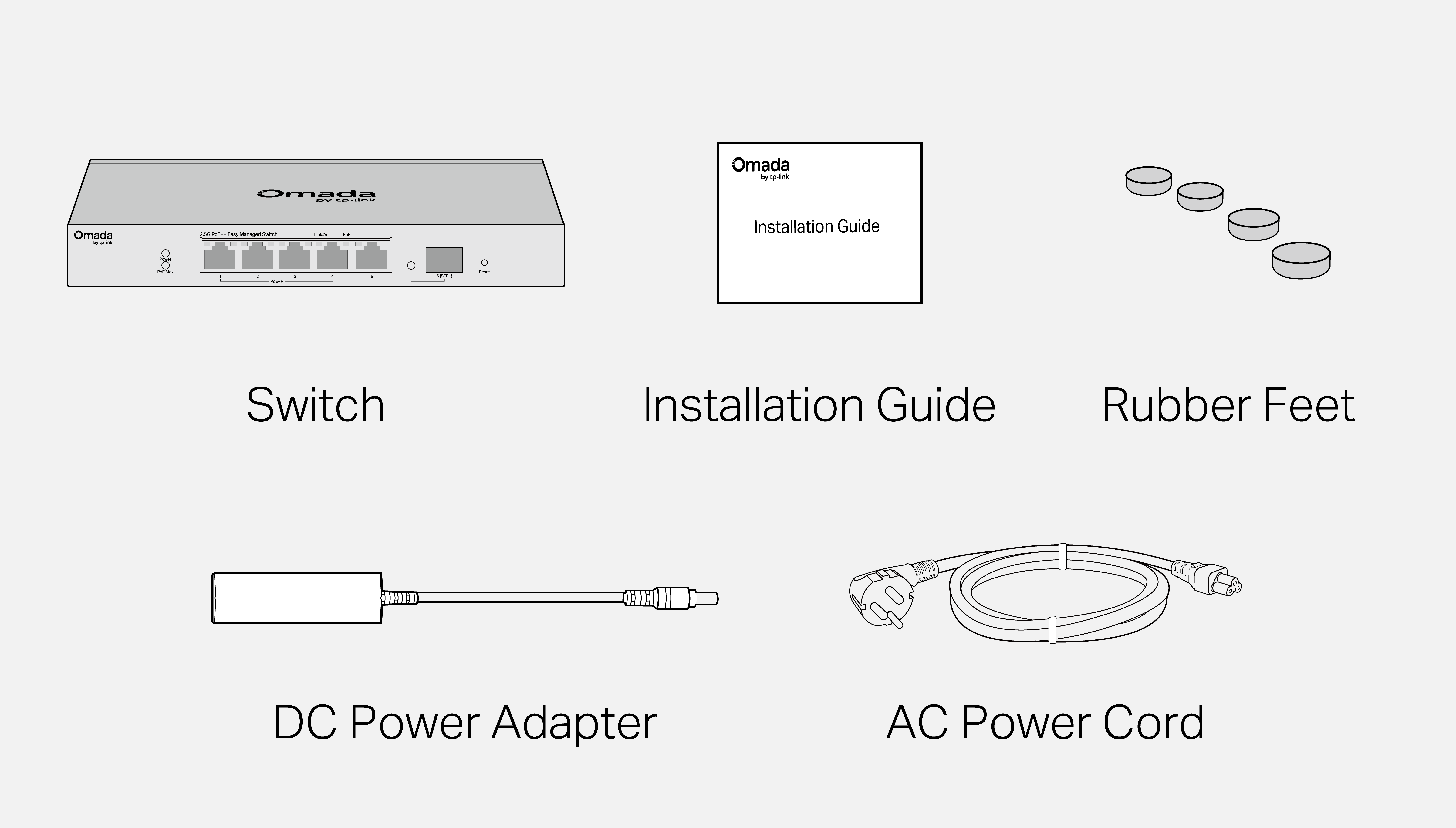
Package Contents
1 Installation
Desktop Installation
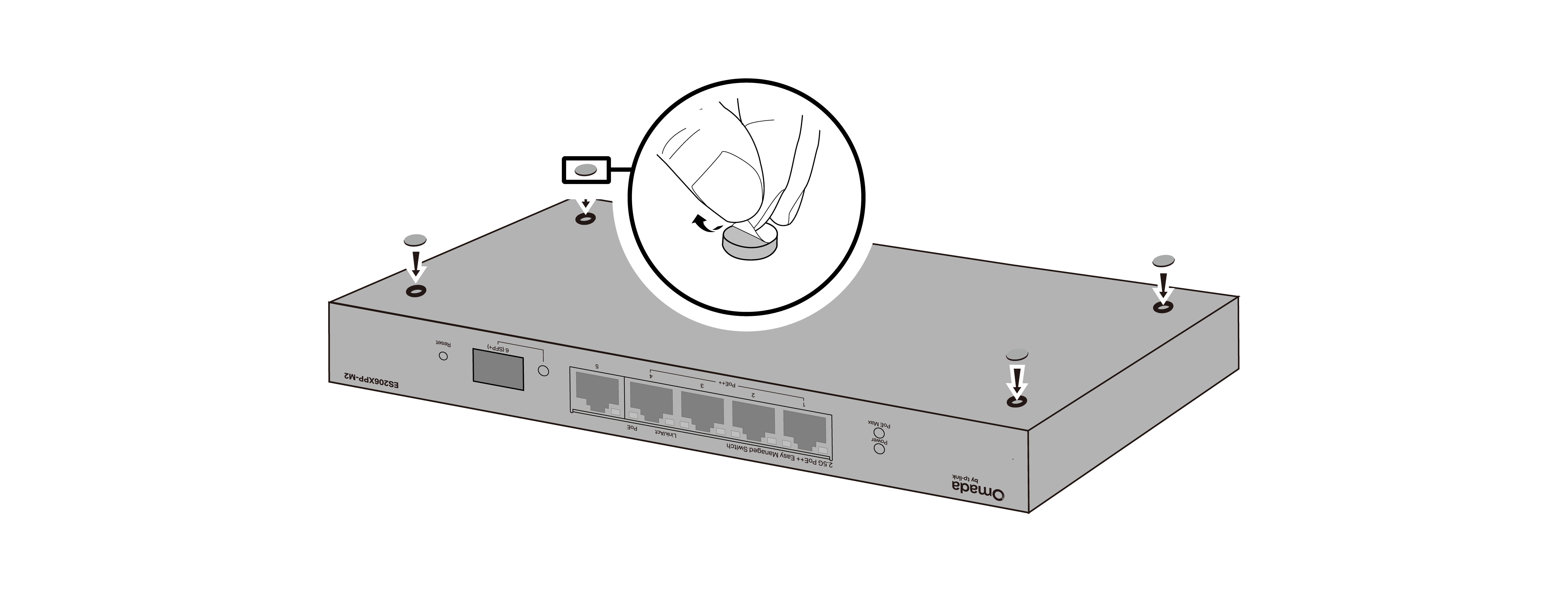
Attach the supplied rubber feet to the bottom of the switch to prevent it from slipping when placed on a desktop.
Note:
Avoid placing the switch on top of another and use the rubber feet to ensure enough clearance for air circulation.
Wall-Mounting Installation
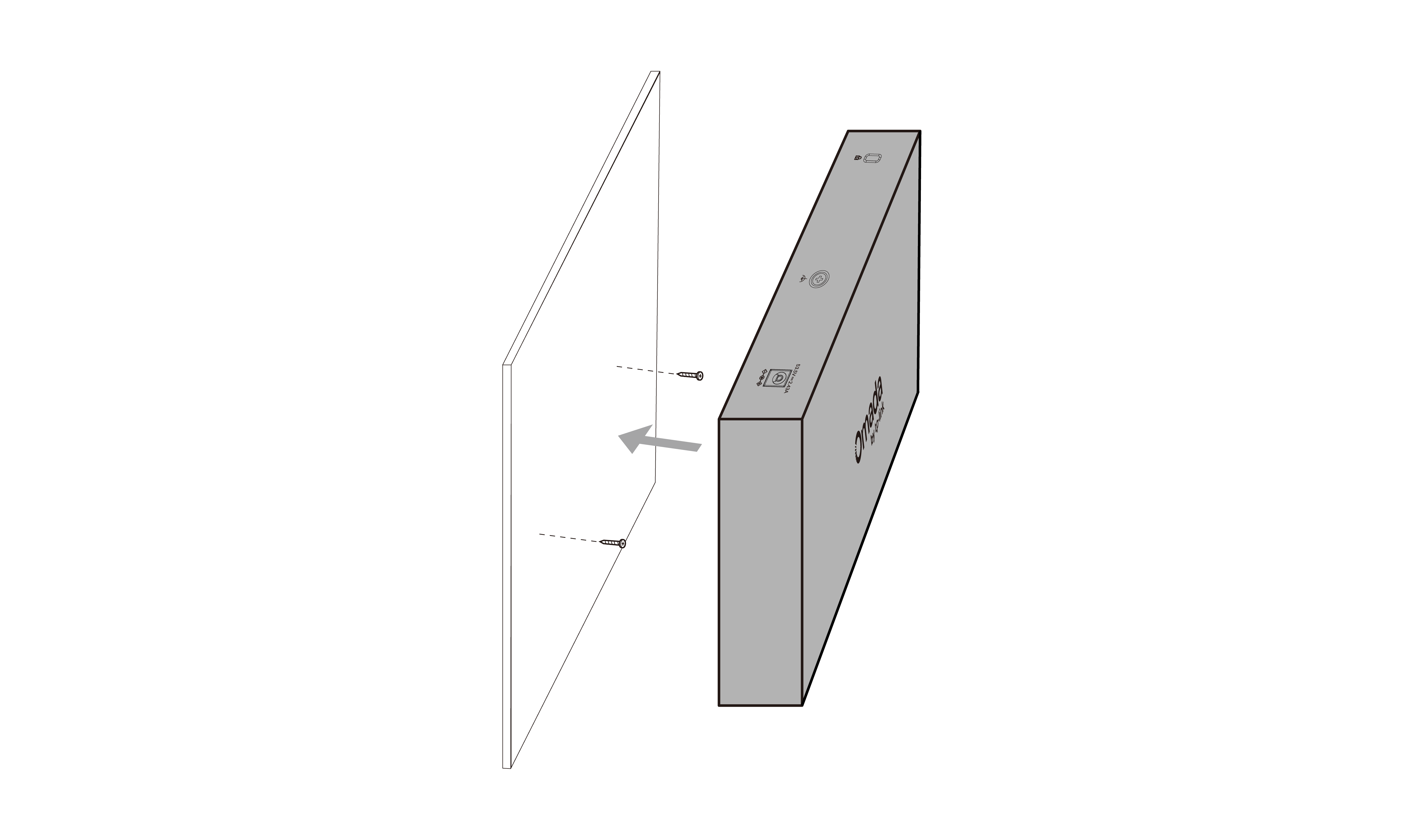
Drill two holes on the wall according to the mounting holes on the bottom of the switch, then secure the switch to the wall with two suitable screws (not provided).
Note:
Ensure enough clearance between the switch and the wall for air circulation.
For detailed information, please refer to the Wall Mounting Guide.
2 Connection
Note:

1. The PoE ports can also connect to non-PoE devices, but only transmit data.
2. The PoE ports shall not be used to charge lithium batteries or devices supplied by lithium batteries.
3. Maximum PoE power is 90 W for each PoE port, and total PoE budget is 120 W.
4. PoE budget calculations are based on laboratory testing. Actual PoE power budget is not guaranteed and will vary as a result of client limitations and environmental factors.
3 Configuration
The switch supports two configuration methods:
· Standalone Mode: Configure and manage the switch individually. To set up a standalone Omada switch, refer to https://www.omadanetworks.com/support/faq/4097/.
· Controller Mode: Configure and manage the network devices centrally. This mode is recommended for large-scale networks with numerous devices, including access points, switches, and gateways. To set up an Omada switch with an Omada Controller, refer to the Omada Controller configuration guide at https://www.omadanetworks.com/support/faq/4096/.
Omada App
With the TP-Link Omada app, you can access and manage your Omada devices at a local site or remotely with a tap of your phone. You can download and install the TP-Link Omada app from the App Store or Google Play.



For detailed instructions on device configuration, refer to the user guides of the Controller and switches. The guides can be found in the support center of our official website: https://support.omadanetworks.com/document/.
4 LED Explanation
| Power | On/Off: Power on/off |
|---|---|
| Link/Act (For ports 1-5) |
On (Green): Running at 2.5 Gbps On (Yellow): Running at 100/1000 Mbps Flashing: Transmitting/receiving data Off: No connected device |
| PoE (For ports 1-4) |
On: Providing PoE power Flashing: Current-overload/Short-circuit Off: Not providing PoE Power |
| PoE Max (For ES205GP/ ES206GP/ ES208GP/ ES210GP/ ES210GMP) |
On: The remaining PoE power is ≤ 7 W Flashing: The remaining PoE power keeps ≤ 7 W after this LED is on for 2 minutes Off: The remaining PoE power is > 7 W |
| SFP+ (For port 6) |
On (Green): Running at 10 Gbps On (Yellow): Running at 1000 Mbps Blinking: Transmitting/receiving data Off: No connected device |
5 Environmental and Physical Specifications
| General Specifications | |
|---|---|
| Standard | IEEE 802.3u, IEEE 802.3ab, IEEE 802.3z, IEEE 802.3bz, IEEE 802.3ae, IEEE 802.3az, IEEE 802.3x, IEEE 802.1p, IEEE 802.1q, IEEE 802.3af, IEEE 802.3at, IEEE 802.3bt |
| Interface | 4 100M/1G/2.5G RJ45 PoE++ Ports 1 100M/1G/2.5G RJ45 Port 1 10G SFP+ Port |
| Transmission Media | 100BASE-TX: UTP category 5, 5e cable (maximum 100 m) 1000BASE-T: UTP category 5e cable or above (maximum 100 m) 1000BASE-SX: 62.5 μm MMF (2 m ~ 275 m) or 50 μm MMF (2 m ~ 550 m) 1000BASE-LX: 62.5/50 μm MMF (2 m ~ 550 m) or 9 μm SMF (2 m ~ 5000 m) 1000BASE-LX10: B1.1, B1.3 SMF (2 fiber) (0.5 m ~ 10 km) 1000BASE-BX10: B1.1, B1.3 SMF (1 fiber) (0.5 m ~ 10 km) 2.5GBASE-T: UTP category 5e cable or above (maximum 100 m) 10GBASE-SR: OM1/OM2/OM3 or above MMF (2 m ~ 300 m) 10GBASE-LR: IEC B1.1 and B1.3 SMF (2 m ~ 10 km) |
| Switching Capacity | 45 Gbps |
| Transfer Method | Store-and-Forward |
| MAC Address Learning | Automatically learning, automatically aging |
| Power Supply | Input: 100-240 VAC, 50/60 Hz Output: 53.5 V DC/2.43 A |
| Wall Mountable | Yes |
| Distance Between Mounting Holes | 150 mm |
| Environmental and Physical Specifications | |
| Operating Temperature | -5 ˚C to 40 ˚C (32 ˚F to 104 ˚F) |
| Storage Temperature | -40 ˚C to 70 ˚C (-40 ˚F to 158 ˚F) |
| Operating Humidity | 10% RH to 90% RH non-condensing |
| Storage Humidity | 5% RH to 90% RH non-condensing |
6 Frequently Asked Questions (FAQ)
Q1. The Power LED is not lit.
The Power LED should be lit when the power system is working normally. If the Power LED is not lit, please check as follows:
A1: Make sure the switch and power source are properly connected through the power adapter.
A2: Make sure the power source voltage meets the input voltage requirements of both the power adapter and the switch.
A3: Make sure the power source is on.
Q2. Why is the Link/Act LED not lit while a device is connected to the corresponding port?
It is recommended that you check the following items:
A1: Make sure that the cable connectors are firmly plugged into the switch and the device.
A2: Make sure the connected device is turned on and working well.
A3: The cable must be less than 100 meters (328 feet) long. If Extend Mode is enabled, it should be less than 250 meters (820 feet).
Q3. Why is PoE Port not supplying power for PoE devices?
When the total power consumption of connected PoE devices exceeds the maximum, the PoE port with a smaller port number has a higher priority. The system will cut off power to the ports with larger port numbers to ensure supplying to other ports.
Take ES206XPP-M2 for example, if port 1, 2 and 4 are consuming 30 W respectively, and an additional PoE device with 60 W is connected to port 3, the system will cut off the power of port 4 to compensate for the overload.
